Yoshio Sakaki
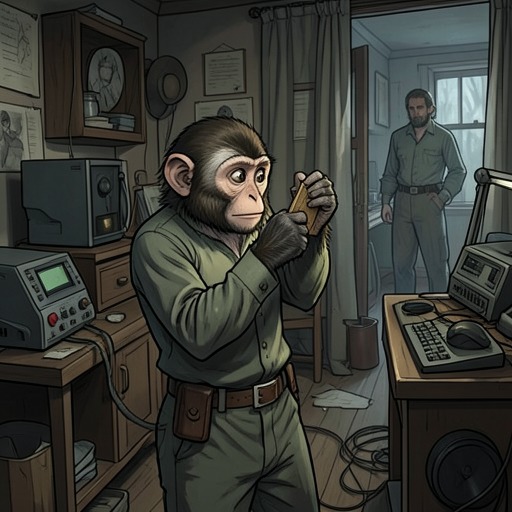
Blind Willow, Sleeping WomanYoshio Sakaki, section chief of the Shinagawa Public Works Department, helps recover Mizuki Ando’s stolen name tags by putting his department’s knowledge of the city’s sewers to use. His role is both municipal and domestic: he organizes the capture of the monkey hiding underground, supports his wife Tetsuko Sakaki’s unusual investigation, and agrees to release the culprit when Mizuki asks him to show mercy. Through him, public infrastructure becomes an unexpectedly humane means of restoring a person’s name and identity.
Identity and Position
Yoshio Sakaki is introduced as a tall, thin man around fifty, dressed in light khaki work clothes and wearing a name tag that identifies him as Sakaki. He is the section chief of the Public Works Department at the Shinagawa Ward Office, a position that gives him access to employees responsible for the city’s sewer system. When Mizuki meets him, he introduces himself as Tetsuko’s husband and identifies his younger colleague, Sakurada, as part of the team that helped recover her name tags.
The distinction between his official responsibilities and his wife’s approach is explicit. Tetsuko acknowledges that she is an oddball whose methods do not fit comfortably with organizations or academia; Yoshio answers that those methods are effective. His brief endorsement locates him as a practical ally rather than the originator of her investigation: he recognizes its value and can turn its conclusions into action through his department.
The Sewer Investigation
The theft of Mizuki’s name tags has left her periodically unable to remember her own name. Tetsuko tells Mizuki that the tags were stolen and recovered, and that their return is why Mizuki can recover her name. Yoshio is the person who makes that recovery possible in practical terms. At Tetsuko’s request, he has colleagues from Public Works search the sewers, where the monkey responsible has been hiding.
Yoshio’s authority fits the problem’s unlikely geography. The monkey’s refuge is not a distant wilderness but the sewer network beneath Shinagawa, and the department responsible for that system can mobilize people to find it. Sakurada says the monkey had used a hideout beneath Takanawa as a base for foraging operations across Tokyo. Yoshio credits the younger worker with doing most of the capture, while Sakurada takes pride in the department’s response to a suspicious figure living in its sewers. The account presents Yoshio as a coordinator who can draw on local knowledge and personnel, not as a lone detective.
The recovery is also an encounter, not simply the retrieval of objects. Yoshio is present when Mizuki comes face-to-face with the monkey, and the stolen tags become the concrete link between her recurring loss of her name and the animal’s compulsion to take names that appeal to it. His department’s intervention brings the hidden cause into view and gives Mizuki the opportunity to address the culprit directly.
Mercy and the Monkey’s Release
Once the monkey admits that it stole Mizuki’s tag as well as Yuko Matsunaka’s, it apologizes and describes its urge as an illness it cannot control. Mizuki insists that the monkey is not evil by nature and asks Yoshio whether, after hearing its explanation, it can be forgiven and released in the mountains. She proposes Mount Takao or another suitable place, reasoning that the monkey has suffered and may not trouble anyone again.
Yoshio accepts her condition without objection. He asks the monkey to swear that it will not return to Tokyo’s city limits, and the monkey promises to stay away from the city and its sewers. His decision shifts the resolution from capture to conditional release: the department’s power to apprehend the animal is used to make a promise possible, while Mizuki’s restored name does not require the monkey’s continued confinement.
Tetsuko then suggests that she and Yoshio drive the monkey to Mount Takao the following weekend. Yoshio agrees, treating the journey as an agreeable test run for their new car. The practical, almost domestic note gives the ending its particular balance: the sewer operation concludes not with a punishment or public spectacle, but with a planned drive that will carry the captured monkey out of the city.
Marriage and Narrative Role
Yoshio’s partnership with Tetsuko rests on a difference in temperament that does not become a conflict. Her methods are unconventional, and she openly describes herself as poorly matched with formal organizations; he does not try to rein her in. Instead, he supplies institutional means when her inquiry reaches a problem his department can solve. His remark that her way works is a concise expression of their complementary roles.
The story gives Yoshio little interior biography, but his actions define his place in the episode: he connects the everyday machinery of municipal government to an intimate disturbance in Mizuki’s life. Sewers, work crews, name tags, and a promise of release all meet in his part of the plot. The result is a quietly comic resolution in which the department charged with maintaining the city’s underground spaces helps return a stolen name, while its chief consents to let the name-stealing monkey begin again elsewhere.